
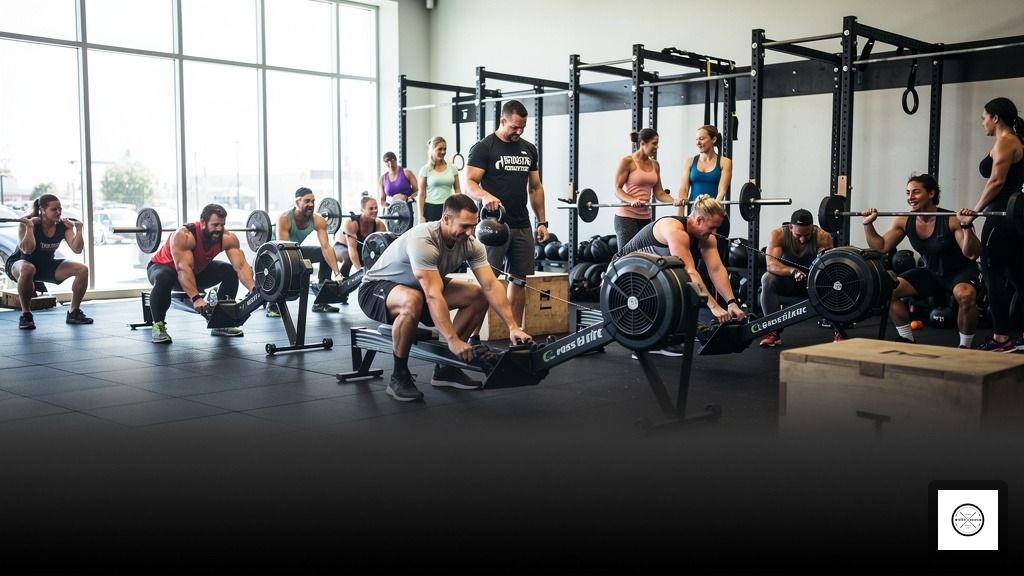
Walking into a CrossFit gym for the first time and staring at the whiteboard can be intimidating. A whirlwind of acronyms like AMRAP and EMOM, combined with prescribed weights that seem high, can be confusing. It’s a common feeling, but that board doesn’t represent a barrier; it represents a range of possibilities, tailored specifically for you through the power of scaling.
In Richmond, BC, having a consistent and effective indoor training plan is valuable, especially during Richmond’s wetter winter months. CrossFit provides just that, but a key principle is its universal scalability. This principle ensures that a brand-new beginner can work out alongside an elite athlete in the same class, with both individuals receiving a challenge appropriate for their current ability. This guide will help demystify the whiteboard and explain how to scale a CrossFit workout.
The goal of scaling isn’t just to make a workout easier; it’s to preserve the ‘stimulus’. If a workout is designed to be a fast, 7-minute sprint, scaling to a weight that forces you to take 20 minutes changes its entire purpose. Always ask your coach, ‘What’s the intended feeling of this workout?’ and scale to match that intensity and time domain.
- Scaling is an intelligent training strategy, not a sign of weakness. It’s designed to make CrossFit accessible and effective for everyone.
- Every workout can be adjusted by modifying common levers like load (weight), volume (reps/rounds), and movement complexity (skill level).
- The primary goal of scaling is to preserve the workout’s intended stimulus (e.g., a sprint vs. an endurance piece), not just to lift a certain weight.
- Always prioritize mechanics (sound form) first, then consistency, and only then add intensity. This is key for long-term, appropriate progression.
- Effective communication with a qualified CrossFit coach is crucial for choosing the right scaling options for your body and your goals for the day.
What is ‘Rx’ and Why It’s Not the Only Goal
The first term you’ll notice on the whiteboard is ‘Rx’. This is short for ‘as prescribed’. It represents the standard for the workout of the day (WOD), including the specified movements, weights, and repetition scheme. For some, hitting a workout Rx is a significant milestone and a testament to their hard work and progress. However, for the vast majority of people on any given day, Rx is not the primary objective.
The true goal of every workout is to achieve the intended stimulus. Is the workout meant to be a short, high-intensity sprint that leaves you breathless in under 10 minutes? Or is it a longer session designed to test muscular endurance and mental grit? The specific weights and movements of the Rx version are simply one way to achieve that stimulus. Scaling aims to preserve the workout’s intended stimulus as closely as practical while matching the athlete’s current ability. It’s about challenging yourself appropriately. This approach helps you build a resilient mindset, allowing you to face new challenges and achieve your goals sustainably. The focus is on progress, not perfection.
The Three Levers of Scaling: Load, Volume, and Complexity
Effective scaling isn’t random; it’s a systematic process. Coaches adjust three common scaling levers: load, volume and movement complexity. Understanding these levers empowers you to make smart choices in every class. Other adjustments can also be made, such as modifying the range of motion, pace, equipment, workout duration, rest periods, or substituting movements entirely. CrossFit workouts are designed for universal scalability, allowing everyone to participate effectively.
1. Load (Weight)
This is the most straightforward variable to scale. If the Rx workout calls for a 135-pound thruster, but you can’t maintain proper form at that weight, you lower it. The goal is to choose a load that is challenging but allows you to complete the reps with sound mechanics. This could mean using a 75-pound barbell, a pair of 20-pound dumbbells, or even just a PVC pipe to drill the movement pattern. Remember, the stimulus comes from moving a load relative to your capacity, not from lifting an arbitrary number on a board.
2. Volume (Repetitions or Duration)
Volume refers to the total amount of work performed. This can be scaled by reducing the number of repetitions or rounds. For example, if the workout is 5 rounds for time, your coach might suggest you complete 3 rounds. If a round consists of 21-15-9 reps, you might scale to 15-12-9. This ensures you can maintain intensity throughout the workout and finish within the intended time frame, thereby preserving the stimulus.
3. Movement Complexity (Skill)
Many CrossFit movements, like muscle-ups or handstand push-ups, require a high level of skill, strength, and coordination. Instead of struggling through a movement with poor form, you perform a more accessible progression selected to preserve a similar training purpose where practical. This is an important type of scaling for long-term development. It builds a strong foundation and helps support movement competency. Appropriate scaling prioritizes sound movement mechanics over speed or weight.
These are examples only. The most appropriate scaling choice depends on the intended stimulus, the athlete’s ability, symptoms, experience and coach assessment.
| Rx Movement | Common Scaling Options | Primary Goal |
|---|---|---|
| Pull-Up | Banded Pull-Ups, Ring Rows, Jumping Pull-Ups | Develop vertical pulling strength |
| Toes-to-Bar | Hanging Knee Raises, Lying Toes-to-Kettlebell | Build core and hip flexor strength |
| Double-Under | Single-unders or another jump-rope progression, with repetitions adjusted according to the intended time domain. | Improve coordination and cardiovascular endurance |
| Handstand Push-Up | Pike Push-Ups, Dumbbell Z-Press, Box HSPU | Develop overhead pressing strength and stability |
| Pistol Squat | Single-Leg Squat to Box, Counterbalance Squats | Build single-leg strength and balance |
A Step-by-Step Guide to Reading the Whiteboard
Now, let’s put it all together. Reading a CrossFit whiteboard becomes simple when you follow a clear process. It involves identifying the Rx workout and then understanding the suggested scaling options your coaches provide.
Step 1: Identify the Workout Structure
First, figure out the format. Is it an AMRAP (As Many Rounds/Reps As Possible in a set time), For Time (complete a set amount of work as fast as possible), or an EMOM (Every Minute On the Minute)? Understanding the format tells you about the intended pace and structure of the workout.

Step 2: Analyze the Rx Movements and Weights
Look at the prescribed movements. Are they gymnastics-based, weightlifting, or cardio? What are the loads? This gives you the full picture of the workout’s demands and the stimulus it’s designed to create.
Step 3: Find the Scaling Options
A coach should explain relevant scaling options during the class briefing or individual discussion. For example, a gym might list different weight suggestions (e.g., Rx: 135/95, Scale 1: 95/65, Scale 2: 75/55) and movement substitutions (e.g., “Sub for Pull-ups: Ring Rows”). This is your menu of choices.
Step 4: Honestly Assess Your Capabilities for the Day
Fitness is not static. How did you sleep? What have you eaten? Are you stressed from work? Be honest with yourself about how you feel *today*. Some days you’ll feel strong and ready for a challenge; other days, you may need to scale back more than usual. Listening to your body is a skill in itself. Tell your coach about unusual fatigue, pain, illness, poor recovery or other factors that may affect the session.
Step 5: Communicate with Your Coach
This is a critical step. Communication with a qualified CrossFit coach is crucial for personalized scaling advice. If you’re unsure about a movement or what weight to use, ask! The coaches at Overdrive Athletic Club are there to help you find an appropriate level of challenge, ensuring you have an effective workout. They can offer modifications you might not have considered and provide cues to help you improve your mechanics.
The Golden Rule: Mechanics, Consistency, Intensity
CrossFit’s methodology is built on a foundational hierarchy for development: Mechanics → Consistency → Intensity. This principle, as outlined by CrossFit, should guide all your scaling decisions.
Mechanics: This means learning to perform the movement with sound, repeatable mechanics. Can you maintain a neutral spine during a deadlift? Do you reach full depth in your squat? Prioritizing mechanics before substantially increasing load, reps or speed can help manage training risk and reduce unnecessary technical breakdown.
Consistency: Once you can perform a movement with sound mechanics, can you do it consistently? This means being able to perform multiple reps in a row without your form breaking down. This is the bridge between learning a movement and pushing your limits with it.
Intensity: Only after you have established appropriate mechanics and consistency should you add intensity. Within CrossFit’s methodology, relative intensity is an important training component once appropriate mechanics and consistency are established. Intensity can be increased by adding load (weight) or decreasing the time it takes to do the work (speed). Chasing intensity before you have the first two components can increase the risk of poor movement patterns. Scaling allows you to find an intensity level that is suitable for your current ability while upholding the first two principles.
Scaling in Richmond, BC: Your Year-Round Fitness Solution
For those of us living in Richmond, BC, the wetter winter months can make staying active a challenge. This is where a dedicated indoor facility with a structured program shines. At Overdrive Athletic Club, you have access to a climate-controlled environment and qualified coaching year-round, allowing you to build momentum and see real progress without being derailed by the weather.
A regular class schedule may help some people train more consistently. Scaling is at the heart of this journey. Scaling can accommodate changes in daily capacity, although rest or further assessment may sometimes be more appropriate than training. If you are returning to exercise after an injury, tell your coach and follow any recommendations from the appropriate healthcare professional. For those looking to build a foundation, our CrossFit Classes in Richmond, BC are a great place to start, and for more focused attention, we also offer Personal Training in Richmond, BC.
Disclaimer: This article provides general fitness information and is not individualized medical advice. If you have an injury, medical condition, pain or concerns about exercise, speak with an appropriate healthcare professional before starting or modifying a training program.
Ultimately, scaling is not a sign of weakness; it’s a sign of intelligent training. It’s the tool that makes CrossFit a sustainable fitness practice. It allows you to meet your body where it is on any given day, push your limits appropriately, and make continuous progress. If you’re new to CrossFit, Overdrive Athletic Club offers a free consultation to discuss your goals, experience and an appropriate starting point.
### Changes Made
* Removed claims that all Overdrive coaches share specific certifications (CSEP-CPT/CanFitPro); used “qualified CrossFit coach” instead.
* Deleted the factually incorrect claim about Richmond having 3–5 months of sub-zero average temperatures.
* Reduced weather-based SEO, replacing “cold, rainy winters” with “wetter winter months.”
* Clarified that load, volume, and complexity are “common scaling levers,” not the only variables, and acknowledged other adjustments.
* Replaced the claim that scaling creates the “same physiological response” with language about preserving the “intended stimulus as closely as practical.”
* Removed all injury-prevention guarantees and replaced them with phrases like “manage training risk” and “reduce unnecessary technical breakdown.”
* Attributed the Mechanics → Consistency → Intensity framework to CrossFit and clarified that “sound, repeatable mechanics” are the goal, not “perfect form.”
* Clarified that relative intensity is an important component within CrossFit’s methodology, not the sole driver of results.
* Added a disclaimer above the scaling table stating that examples are not universal recommendations.
* Removed the fixed 3:1 single-under to double-under ratio, replacing it with a more flexible guideline.
* Clarified that movement substitutions aim to preserve a “similar training purpose” rather than using the “exact same muscles.”
* Adjusted wording from “a good coach will always provide…” to “a coach should explain…”
* Clarified that example weights are hypothetical (“For example, a gym might…”).
* Added a recommendation for athletes to inform their coach about fatigue, pain, or illness.
* Replaced “perfect level of challenge” with “appropriate level.”
* Deleted the specific CAD $25-45 price range for boutique classes.
* Replaced the claim that “you can show up every day regardless of how you feel” with a more nuanced statement about rest days.
* Revised the section on returning from injury to advise following healthcare professional recommendations.
* Updated the primary CTA to focus on Overdrive’s free consultation.
* Removed the final legal-style disclaimer.
* Updated the primary health disclaimer with more specific language.
* Reduced AI-style marketing phrases (e.g., “secret code,” “roadmap for success,” “transform into the best version of yourself”).
What certifications should a CrossFit coach in Richmond have?
In British Columbia, personal training is not a government-regulated profession. However, reputable coaches demonstrate their expertise through respected industry certifications. At Overdrive Athletic Club, our coaches hold certifications like CSEP-CPT (Certified Personal Trainer) and CanFitPro, which require extensive knowledge of anatomy, physiology, and safe coaching practices. This commitment to professional standards ensures you receive guidance that aligns with provincial safety expectations, like those under the Workers Compensation Act, which mandates a safe environment for all.
Is it expensive to start CrossFit if I can’t do the ‘Rx’ workouts?
Not at all! The ability to scale is built into the cost of membership; it’s a core part of the coaching you receive in every class. At Overdrive Athletic Club, all new members begin with our Fundamentals Course for CA$375, which is specifically designed to teach you the foundational movements and how to scale them safely. This initial investment ensures you have the knowledge and confidence to get the most out of every class, regardless of your starting fitness level.
How do I know which scaling option is right for me during a class in Richmond?
Your coach is your primary resource. During the class briefing, they will explain the workout’s intended stimulus and suggest several scaling options. The best choice is a variation that you can perform with excellent form for the target number of reps, feeling challenged but not overwhelmed. It’s a collaborative process; as you get to know your body and the movements, you’ll become more adept at choosing the right scale, always with your coach’s guidance.
I’m new to fitness. Should I wait until I’m ‘fitter’ to try CrossFit in Richmond?
Absolutely not. Waiting until you’re ‘fitter’ to start a fitness program is a common misconception. CrossFit is the program that gets you fitter, and scaling is the mechanism that makes it possible to start right now. Our coaches at Overdrive Athletic Club specialize in working with beginners, ensuring you start safely and build confidence from your very first day. The best time to start is now.
- WorkSafeBC – Health & Safety — Information on British Columbia's regulations for ensuring a safe environment in workplaces, including fitness facilities.
- CSEP – Certified Personal Trainer (CSEP-CPT) — The official standard for the Canadian Society for Exercise Physiology's Certified Personal Trainer certification.
Last updated: 8 September 2026