
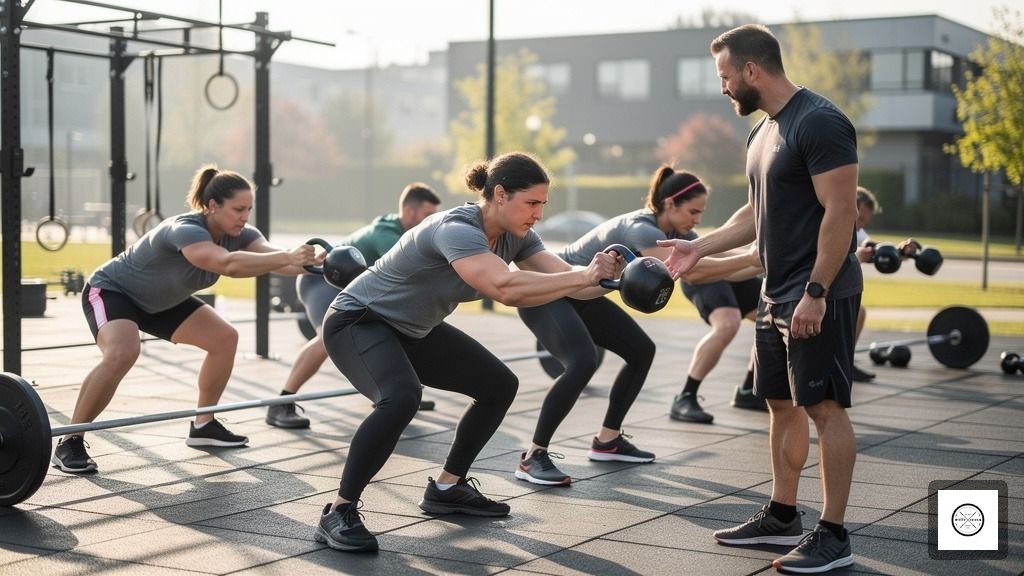
A single boutique spin class in Richmond, BC now runs $100 to $280 CAD a month, and that gets you exactly one thing: cardio conditioning on a bike. A separate yoga membership for mobility work adds another $100 to $280. Add a personal trainer for strength work at $80 to $180 CAD per session, and a single person chasing complete fitness could be paying for three or four different memberships just to cover what one well-run CrossFit class does in an hour.
That’s the comparison worth making before you sign up for anything. Richmond’s fitness market is dense — options for CrossFit in Richmond, BC sit within a few kilometres of spin studios, yoga rooms, and bootcamp franchises, all competing for the same members.
What Single-Modality Classes Actually Train
Yoga, spin, and Pilates studios are built around one movement pattern repeated with variation. Spin trains cardiovascular endurance and leg endurance. Yoga trains flexibility, balance, and some isometric strength. Pilates trains core stability and control. Each is genuinely good at what it does — that’s not in dispute.
The gap shows up when you look at what Health Canada actually recommends. Adults are advised to accumulate at least 150 minutes of moderate-to-vigorous aerobic activity weekly, combined with strength training at least 2 days per week — a comprehensive approach that a single-modality class rarely covers on its own. A twice-weekly spin habit satisfies the cardio side but leaves the strength requirement untouched. Most people don’t realize this until a coach points it out.
Bootcamp and HIIT classes get closer, mixing bodyweight strength moves with cardio intervals. But most run on a fixed circuit format that doesn’t track or progress your specific lifts over time. You might do the same 30-second burpee-and-squat circuit in January that you did in September, with no structured way to know if you’re actually getting stronger.
What CrossFit Adds to the Mix
CrossFit programming rotates through strength work, gymnastics-based bodyweight movement, and metabolic conditioning across a training week, often in the same hour-long class. A Monday might open with back squats, move into gymnastics skill work like pull-ups or handstand progressions, then finish with a short, intense conditioning piece. That structure directly overlaps with the aerobic-plus-strength combination Health Canada recommends, rather than treating them as separate memberships.
This matters more than it sounds. According to Statistics Canada self-reported data (2021), 65.0% of Canadian adults were classified as overweight or obese — a figure that points to real demand for fitness programs that build both cardiovascular capacity and lean muscle at the same time, not one or the other. A program that only does cardio, or only does strength, is solving half the problem.
The other piece bootcamp classes often miss is coaching depth. A qualified coach in a CrossFit class is scaling movements in real time — swapping a barbell deadlift for a kettlebell version for someone with a cranky lower back, or reducing rep counts for someone new to the format. That’s a different skill set than leading a spin class through a playlist, and it’s part of why CrossFit classes at Overdrive Athletic Club are led by coaches holding CSEP-CPT or CanFitPro PTS certifications — national standards for safe, individualized program design, not just class facilitation.
Comparing the Real Costs
Here’s where the numbers matter. Standard gym memberships, the kind offering unstructured group classes and open gym access, typically run $35 to $90 CAD per month across Canada. Boutique single-modality studios — yoga, spin, Pilates — usually charge more, in the $100 to $280 CAD per month range, largely because of specialized equipment, smaller class sizes, and instructor expertise in one narrow discipline.
| Fitness Option | Typical Monthly Cost (CAD) | What’s Trained |
|---|---|---|
| Standard gym membership | $35-90 | Open access, loosely structured classes |
| Boutique studio (yoga, spin, Pilates) | $100-280 | Single modality, high specialization |
| CrossFit membership | $150-250 | Strength, conditioning, and skill work |
| Personal training (1-on-1) | $80-180 per session | Fully individualized, any goal |
| Online fitness platform | $25-75 | Self-directed, app-based programming |
| Specialized wellness program | $150-500 per program | Nutrition, recovery, targeted outcomes |
CrossFit membership pricing generally lands between the standard gym and boutique studio range, but the comparison isn’t really about the number on its own — it’s about what one hour buys. A single CrossFit class covers strength programming, conditioning, and coached technique work that would otherwise require separate memberships at a spin studio and a personal trainer. For exact current rates, membership pricing at Overdrive Athletic Club is available on request.
Not every budget supports a full CrossFit membership right away, and that’s fine. Some people start with drop-in classes to test the format before committing monthly. That’s a reasonable way to see if the coaching style and community fit before locking into a longer commitment.
Safety and Consumer Protections That Actually Apply
Any fitness business operating in BC, regardless of format, falls under BC’s Workers Compensation Act and its associated Occupational Health and Safety Regulation, which require a safe training environment, properly maintained equipment, and appropriately trained staff. This applies equally to a CrossFit box, a spin studio, and a standard commercial gym — it’s not a CrossFit-specific requirement, and it’s worth knowing that no single format has a monopoly on safety standards.
On the contract side, Provincial Consumer Protection Acts govern how membership agreements are written, including cancellation terms and pricing transparency. Before signing anything — CrossFit or otherwise — it’s worth reading the cancellation clause carefully. This applies whether you’re joining a boutique yoga studio or a group fitness gym, and it’s a detail that gets glossed over more often than it should.
CSEP-CPT and CanFitPro certifications are voluntary industry credentials, not government licences. They indicate a coach has met a national training and program-design standard, but they aren’t a regulatory requirement to work as a fitness coach in BC. That distinction matters when you’re comparing credentials between studios.
What This Means If You’re Choosing Between Formats
If your main goal is flexibility and low commitment — a mobility routine, stress relief, general movement — a single boutique modality like yoga might genuinely be enough. Not everyone needs varied strength and conditioning programming, and there’s no shame in that.
But if the goal is broader — building strength, improving conditioning, and doing it inside one coached hour rather than juggling three separate memberships — that’s the gap CrossFit programming is built to close. Personal training is available for those who want fully individualized attention rather than a group setting, and nutrition coaching pairs well with either format if diet is the missing piece. For anyone managing a nagging injury, physiotherapy and rehab support can run alongside group training rather than replacing it.
Overdrive Athletic Club describes its own approach simply: the goal is to make the workout hour genuinely the best part of your day, not something to grind through. That mindset shows up in how classes are coached — quick, varied, and built around real coaching rather than a fixed playlist. Some members also ask about HSA/FSA eligibility for membership costs, which is covered in more detail here.
Making the Decision for 2026
The honest answer is that no single format is objectively best for every person. Someone training for a specific endurance event may still need dedicated spin or running work alongside strength sessions. Someone recovering from a joint injury may need physiotherapy-led rehab before jumping into varied barbell work. Format choice depends on your starting point, your goals, and frankly, what keeps you showing up consistently — the best program on paper means nothing if you dread walking in the door.
What CrossFit adds for most people chasing general fitness is consolidation: one coached hour that covers strength, conditioning, and skill work, led by coaches trained to individual national standards rather than a generic class script. Overdrive Athletic Club’s mission goes beyond just the workout — it’s about facing new challenges, building a resilient mindset, and becoming a stronger version of yourself over time, not just burning calories for an hour.
What to Expect in Your First Class
An introductory session is designed to be welcoming, not intimidating. Expect it to last about 60 minutes. You’ll meet a coach, tour the facility, and learn a few foundational movements in a small group or one-on-one setting. The focus is on safe technique, not high intensity. Just bring a water bottle, wear comfortable workout clothes, and come with an open mind — no prior experience is necessary.
If you’re weighing a boutique studio membership against a CrossFit box in Richmond, the clearest way to find out which fits is to try a class. Contact Overdrive Athletic Club at (778) 909-7257 or visit 7371 Elmbridge Way, Richmond, BC V6X 1B8 to book a free intro session and see the coaching difference firsthand.
Are CrossFit coaches in Richmond, BC required to hold any certification?
There’s no government licensing requirement for personal trainers or CrossFit coaches in BC — these are voluntary industry credentials, not regulated professions. Overdrive Athletic Club coaches hold certifications such as CSEP-CPT (Certified Personal Trainer) and CanFitPro PTS (Personal Training Specialist), which demonstrate national standards in exercise science, program design, and safe coaching practice.
How much does CrossFit cost compared to a yoga or spin studio in Richmond, BC?
Boutique single-modality studios like yoga, Pilates, or spin typically charge $100 to $280 CAD per month in Canada, while standard gym memberships run $35 to $90 CAD monthly. CrossFit membership generally falls between these ranges, though the comparison should also account for what’s included — a CrossFit class combines strength, conditioning, and coaching that would otherwise require separate memberships.
What does a typical CrossFit class actually involve compared to a bootcamp?
A CrossFit class typically rotates strength work, such as squats or deadlifts, with gymnastics-based movement and a conditioning piece, all coached and scaled to the individual. Bootcamp classes often repeat a fixed circuit format week to week without the same structured progression across strength, skill, and conditioning.
How do I know if group fitness classes are meeting Health Canada’s activity recommendations?
Health Canada recommends adults get at least 150 minutes of moderate-to-vigorous aerobic activity weekly plus strength training at least 2 days per week. Attending CrossFit classes 3 to 4 times weekly typically covers both components in one program, whereas single-modality classes like spin or yoga alone often only address one side of that recommendation.
Last updated: 29 July 2026