
You bend down to tie your shoes, and there it is again—that familiar, unwelcome twinge in your knee. Or maybe it’s the dull ache that sets in after a walk around Garry Point Park, making you think twice about taking the stairs. For many people in Richmond, this kind of nagging knee pain feels like a permanent barrier to trying something more intense, like CrossFit. The common question we hear is, “My knees are already bad. Won’t CrossFit just make them worse?”
It’s an understandable fear. You see videos of athletes lifting heavy weights and jumping on boxes, and it’s natural to assume that kind of impact is the last thing your knees need. But what if the opposite were true? What if a properly coached CrossFit program could be one of the best things you do for your knees?
At Overdrive Athletic Club, we believe that movement is medicine. The issue isn’t the squat; it’s *how* you squat. The problem isn’t the workout; it’s the lack of a plan tailored to you. Let’s break down how we approach knee health, so you can move from feeling limited to feeling empowered.
Understanding the Real Source of Knee Pain
When your knees hurt, it’s to blame the joint itself. But more often than not, the knee is just the messenger delivering bad news from elsewhere. The pain you feel is frequently a symptom of underlying issues that a good strength program is designed to fix. The most common culprits we see are:
- Muscle Imbalances: Many of us have overdeveloped quadriceps (the front of the thigh) and underdeveloped glutes and hamstrings (the back of the body). When you squat or lunge, your body defaults to using those strong quads, putting extra strain on the patellar tendon. Strong glutes and hamstrings are essential for stabilizing the knee and sharing the load.
- Poor Mobility: Stiff ankles or tight hips are a major cause of knee pain. If your ankles don’t have enough range of motion, your body will compensate by collapsing your knees inward or lifting your heels during a squat. If your hips are tight, your lower back and knees have to do work they weren’t designed for.
- Incorrect Movement Patterns: Years of moving inefficiently—sitting for long periods, favouring one leg—can train your body to perform basic movements incorrectly. A common example is “knee valgus,” where the knees cave inward during a squat. This puts significant stress on the ligaments and cartilage inside the joint.
The CrossFit Solution: Building Stronger, More Resilient Knees
A high-performance training program isn’t about ignoring pain; it’s about eliminating it by addressing the root cause. This is where expert coaching makes all the difference. Instead of being “bad for your knees,” CrossFit, when done correctly, systematically builds the support structure your knees have been missing.
The Power of Scaling: Every Movement is for Every Body
“Scaling” is the most important concept for anyone starting CrossFit, especially with pre-existing concerns. It doesn’t mean doing an “easier” workout; it means doing the version of the workout that is right for your current ability level to achieve the intended stimulus safely. An experienced coach has a toolbox of modifications for every movement.
- Problem: Deep squats hurt.
Solution: Box Squats. We place a box behind you and have you squat until you are seated on it. This controls the depth precisely, allowing you to work in a pain-free range of motion while still building strength in your glutes and quads. Over time, we can gradually lower the box as your strength and mobility improve. - Problem: Jumping is too high-impact.
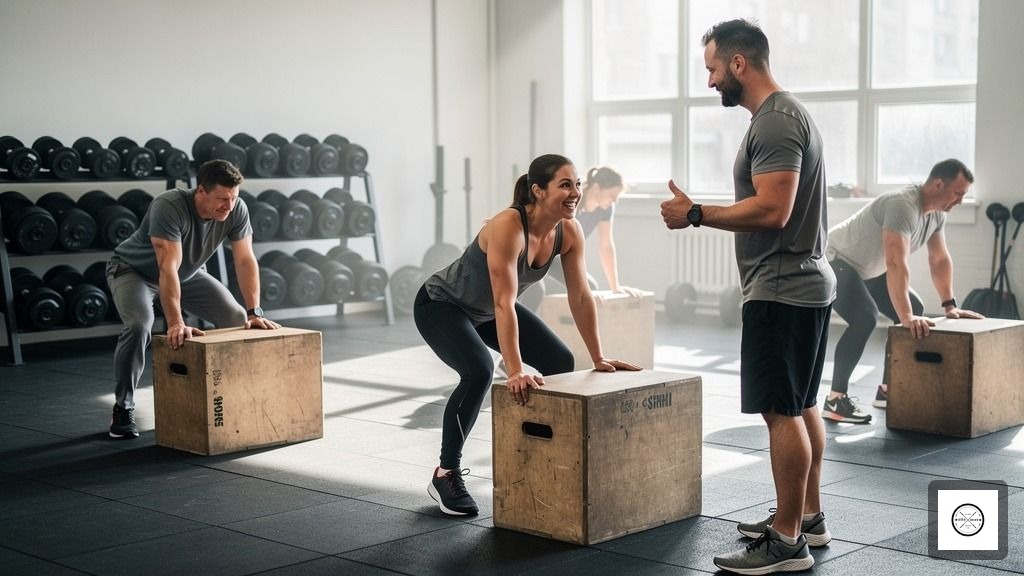
Solution: Box Step-Ups. Instead of jumping onto a box, you simply step up, one leg at a time. This removes the impact while still providing a powerful workout for your legs and improving single-leg stability—a key component of knee health. - Problem: Running causes a flare-up.
Solution: Use the Rower or Bike. Our gym is equipped with low-impact cardio machines. The rower and stationary bike provide an incredible cardiovascular workout without any of the pounding associated with running on pavement.
These aren’t compromises; they are intelligent adjustments. This approach is central to our CrossFit Classes in Richmond, BC, ensuring everyone from a competitive athlete to a complete beginner gets a safe and effective workout.
When to See a Professional First
While a good coach can manage and help improve general aches and weaknesses, some signs indicate you should get a professional assessment before starting any new fitness program. Your coach is not a medical professional and will always recommend you consult one if you experience:
- Sharp, stabbing, or shooting pain during movement.
- A feeling of locking, catching, or giving way in the knee.
- Significant swelling or redness around the joint.
- Pain that persists or worsens even when you are at rest.
In British Columbia, you have several options. A Physiotherapist, regulated by the CPTBC, is an excellent first point of contact for diagnosing an injury and creating a specific rehabilitation plan. They can provide a clear diagnosis and guidelines on which movements to avoid and which to focus on. A Chiropractor (regulated by the CCBC) can also assess and treat issues related to joint mechanics and alignment. Once you have a diagnosis, a BCAK-registered Kinesiologist can work with you on corrective exercises and movement retraining.
Building a Foundation with One-on-One Attention
If you’re feeling particularly apprehensive about joining a group setting, or if you have a complex injury history, starting with one-on-one sessions can be a game-changer. Our Personal Training in Richmond, BC allows a coach to dedicate 100% of their attention to you. We can perform a detailed movement assessment, work on specific mobility drills, and build a solid, pain-free foundation before you even think about joining a class. It’s the most effective way to build confidence and ensure your body is ready for the dynamic environment of group training.
Don’t let the fear of knee pain keep you on the sidelines. With the right guidance, scaling, and a focus on quality movement, you can leave those nagging aches behind and build a stronger, more capable body than ever before. It all starts with a conversation.
Ready to find out how we can tailor a program for your specific needs? Call the team at Overdrive Athletic Club on (778) 909-7257 and speak with one of our expert coaches today.
Is jumping required in CrossFit?
Will squatting make my knee pain worse?
What’s the difference between muscle soreness and joint pain?
Should I see a doctor or physiotherapist before starting CrossFit?
Last updated: 22 July 2026